Showing posts with label yahoo api. Show all posts

Thursday, July 10, 2008

Yahoo's new Search BOSS API

Yahoo has just released a new web search API called BOSS (Build your Own Search Service) which improves on their earlier API in several ways:
  1. No daily query limits.

  2. No restrictions on how the results are displayed, ordered, or mixed in with other proprietary results.

  3. Ability to make money showing paid results.

The BOOS API is REST-based. You can receive results in either JSON or XML format, and you can get 10-50 results back per query.

There is one item that appears to be missing without explanation: the cached URL of each search result. This URL is useful to the user when the result's live URL is not responding. The old Yahoo web search API did provide this, so I'm not sure why it dropping in Boss.

One thing that makes me a little nervous about the API from a researcher's perspective is the prohibition in their Terms of Service against analyzing their search results:
You will not, will not attempt, or will not permit or take actions designed to enable other third parties to: ... perform any analysis, reverse engineering or processing of the Web Search Results
Analyzing the Yahoo search results is exactly what I did in my paper Agreeing to Disagree: Search Engines and their Public Interfaces. Well, better to do and ask forgiveness than get permission up front. ;-)

So here's a simple example in Java using the new BOSS API to search for the title of my blog "questio verum", the index status of my blog's root page, and all the pages indexed for my blog. To make this example work for you, simply put your Yahoo API key in API_KEY.

Note that this example is very similar to the Google AJAX example in Java from last month.

import java.io.BufferedReader;
import java.io.InputStreamReader;
import java.net.URL;
import java.net.URLConnection;
import java.net.URLEncoder;
import org.json.JSONArray; // JSON library from http://www.json.org/java/
import org.json.JSONObject;

public class YahooQuery {

// Yahoo API key
private final String API_KEY = "Your Key Here";


public YahooQuery() {

makeQuery("questio verum");
makeQuery("url:http://frankmccown.blogspot.com/");
makeQuery("site:frankmccown.blogspot.com");
}

private void makeQuery(String query) {

System.out.println("\nQuerying for " + query);

try
{
// Convert spaces to +, etc. to make a valid URL
query = URLEncoder.encode(query, "UTF-8");

// Give me back 10 results in JSON format
URL url = new URL("http://boss.yahooapis.com/ysearch/web/v1/" + query +
"?appid=" + API_KEY + "&count=10&format=json");
URLConnection connection = url.openConnection();

String line;
StringBuilder builder = new StringBuilder();
BufferedReader reader = new BufferedReader(
new InputStreamReader(connection.getInputStream()));
while((line = reader.readLine()) != null) {
builder.append(line);
}

String response = builder.toString();

JSONObject json = new JSONObject(response);

System.out.println("\nResults:");
System.out.println("Total results = " +
json.getJSONObject("ysearchresponse")
.getString("deephits"));


System.out.println();

JSONArray ja = json.getJSONObject("ysearchresponse")
.getJSONArray("resultset_web");

System.out.println("\nResults:");
for (int i = 0; i < ja.length(); i++) {
System.out.print((i+1) + ". ");
JSONObject j = ja.getJSONObject(i);
System.out.println(j.getString("title"));
System.out.println(j.getString("url"));
}

}
catch (Exception e) {
System.err.println("Something went wrong...");
e.printStackTrace();
}
}

public static void main(String args[]) {
new YahooQuery();
}
}


Running this program produces the following results:


Querying for questio verum

Total results = 13600

Results:
1. Questio Verum
http://frankmccown.blogspot.com/
2. WikiAnswers - What does questio verum mean
http://wiki.answers.com/Q/What_does_questio_verum_mean
3. Questio Verum: URL Canonicalization
http://frankmccown.blogspot.com/2006/04/url-canonicalization.html
4. Questio Verum: WIDM 2006
http://frankmccown.blogspot.com/2006/11/widm.html
5. Questio Verum: Fav5
http://frankmccown.blogspot.com/2007/09/fav5_29.html
6. Questio Verum: Fav5
http://frankmccown.blogspot.com/2007/12/fav5.html
7. Questio Verum: August 2006
http://frankmccown.blogspot.com/2006_08_01_archive.html
8. Amazon.com: Profile for Questio Verum
http://www.amazon.com/gp/pdp/profile/A2Q6CLLQPXG55A
9. Questio Verum: JCDL 2007 - day 2
http://frankmccown.blogspot.com/2007/06/jcdl-2007-day-2.html
10. Questio Verum: OA debate - Eysenbach and Harnad
http://frankmccown.blogspot.com/2006/05/oa-debate-eysenbach-and-harnad.html


Querying for url:http://frankmccown.blogspot.com/

Total results = 1

Results:
1. Questio Verum
http://frankmccown.blogspot.com/


Querying for site:frankmccown.blogspot.com

Total results = 4080

Results:
1. Questio Verum
http://frankmccown.blogspot.com/
2. Questio Verum: OA debate - Eysenbach and Harnad
http://frankmccown.blogspot.com/2006/05/oa-debate-eysenbach-and-harnad.html
3. Questio Verum: JCDL 2007 - day 2
http://frankmccown.blogspot.com/2007/06/jcdl-2007-day-2.html
4. Questio Verum: No singles here
http://frankmccown.blogspot.com/2007/08/no-single-here.html
5. Questio Verum: Pledge Week and Insults
http://frankmccown.blogspot.com/2007/10/pledge-week-and-insults.html
6. Questio Verum: WIDM 2006
http://frankmccown.blogspot.com/2006/11/widm.html
7. Questio Verum: Fav5
http://frankmccown.blogspot.com/2007/09/fav5_29.html
8. Questio Verum: August 2006
http://frankmccown.blogspot.com/2006_08_01_archive.html
9. Questio Verum: Fav5
http://frankmccown.blogspot.com/2007/06/fav5.html
10. Questio Verum: Fav5
http://frankmccown.blogspot.com/2007/12/fav5.html


Thanks, Martin, for the head's up on this.

Update on 7/28/2008:

The missing cached URL feature is apparently coming soon.

Tuesday, March 20, 2007

Search engine interfaces and their APIs - How synchronized are they?

A few months ago I gave a little teaser about some research I was doing comparing the results you receive from the search engine APIs of Google, Yahoo, and MSN with the results that you see when you use their web user interface (WUI). The WUI is a fancy term for the little search box that you enter your queries into.

Most API users think that if they search for “march madness”, for example, that the returned results will be equivalent to what they would see if they searched for “march madness” using the WUI. In practice, this rarely occurs.

This leads us to ask, how different are the search engine API results from the WUI results? Are the APIs serving off of older indexes? Smaller indexes? Which search engine offers the most synchronized interfaces?

I will be presenting the answer to these questions at this year’s ACM IEEE Joint Conference on Digital Libraries (JCDL) this June in a paper entitled Agreeing to Disagree: Search Engines and their Public Interfaces. I’ll also be presenting a summary of my findings as a poster at the World Wide Web conference in May. Detailed findings can be found here. If you attend either of these conferences, please come by and introduce yourself... I’d be happy to discuss my findings with you.

By the way, if you haven't heard already, Google's SOAP web search API has been "depricated."

Friday, November 03, 2006

Do the search engine APIs lie?

OK, the title of this post is a little strong. Search engine APIs don't intend to deceive anyone, but they typically do not give the same result as what the rest of the world sees when using the public web interfaces.

Everyday for the past 5 months I’ve been sending thousands of queries to the Google, MSN, and Yahoo on the Internets using the web user interface (WUI), the little box that everyone types their queries into, and using the web search APIs that each of the search engines makes available for free to the public. There’s been a lot of questions as to whether the APIs give the same results as the WUIs, and I’m going to be the first to provide a strong quantitative analysis to see which API's are the most synchronized with their WUIs.

In order to process the incredible amount of data I’ve been collecting, I’ve developed an elaborate set of Perl scripts that transform the raw collected data into tables that are then imported into MySQL. The scripts take several days to complete processing. Then I’ve developed numerous R scripts that pull data from MySQL and plot them to an array of graphs.

I’m currently working on writing up my findings for a conference. If you’d like a pre-print of my paper, I’d be happy to share it with you. Here’s a little teaser.


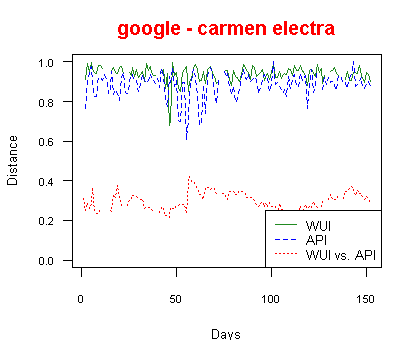
The graph above shows the daily Kendall tau distance between the top 100 search results obtained from Google’s WUI and API for the term carmen electra. The green line shows how the WUI results change every day, and the blue like shows how the API results change every day. If the results are exactly the same (including their ranking), the distance is 1, but if the results have nothing in common, the distance is 0. The red line shows the distance between the WUI and API results each day. You’ll notice that for the most part the WUI and API values don’t move in a synchronized way, and the WUI and API results are very dissimilar. Other popular search terms like stacy keibler, jessica simpson, and lindsay lohan exhibited similar patterns (although the WUI vs API distance was closer to about 0.8). When we examine search results for terms like nfl football or computational complexity, the WUI and API results are very synchronized, and the WUI vs API distance is closer to 0.9. Maybe they purposefully discriminate against air-heads?


This graph shows the decay of the search results for the term subroutine for all three search engines. To compute decay, I compared the results obtained on each day with each of the results after that day using a normalized overlap measure. In other words, I computed the percentage of results that were shared between the results obtained on day 1 with day 2, 3, 4, etc. Yahoo shows a strong decay line with a half-life of 30 (on day 30 half of the results were gone). Google and MSN show decay lines that actually un-decay (if there is such a word). After several months of the results becoming more different, the results start to return back to their starting point.


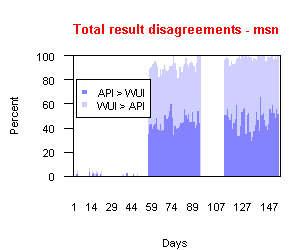
One last graph: how many times does the WUI and API agree when asked for the total number of results for a search term? For all three search engines, the answer is almost always zero! But if you look at the graph above, you’ll see that the MSN total results used to agree almost every time until day 58 (late July) when they changed something internally. Now about half of the time their WUI gives a larger number, and the half of the time the API gives a larger number. By the way, the gap under day 107 was due to MSN invalidating our API license key. It took me 17 days before I replaced the key. Moral of the story- keep a close eye on your experiments!

Thursday, June 08, 2006

Yahoo - Error 999

Yesterday I finally received the coveted “Error 999” page from Yahoo:
Sorry, Unable to process request at this time -- error 999.
Unfortunately we are unable to process your request at this time. This error is usually temporary. Please try again later.
If you continue to experience this error, it may be caused by one of the following:
  1. You may want to scan your system for spyware and viruses, as they may interfere with your ability to connect to Yahoo!. For detailed information on spyware and virus protection, please visit the Yahoo! Security Center.

  2. This problem may be due to unusual network activity coming from your Internet Service Provider. We recommend that you report this problem to them.
While this error is usually temporary, if it continues and the above solutions don't resolve your problem, please let us know.
Just like Google, Yahoo appears to also be monitoring for high volume traffic/automated requests and denying access for a period of time from infringing IP addresses.

I have a couple of scripts that make 300 queries per day to Yahoo using their web interface. 126 of my queries received the error yesterday, and 125 today. The scripts ran for 11 days before being detected. You’d think 300 queries wouldn’t be enough to trigger the response! I’m also making the 300 same queries using the API to see what the difference is in their responses.

I’ve seen others complain of the 999 error dating back to April 2004, but this is the first time I have personally experienced it. Murray Moffatt shares his experience with the error and some possible fixes. Basically all you can do if you are running a script and encounter the page is to sleep for several minutes and try again.

Update: 6/9/06

Today I increased the wait time between each query to a random number of seconds between 3-8. I also ran the script at 8:00 am EST instead of 2:00 am EST to see if blending into the croud helped at all. Today I received 133 error 999s. Not good. Possibly I'm being punished because I'm making requests at a high volume time. Next: increase the wait time to 15-20 seconds between each query.

Thursday, March 09, 2006

Yahoo API has gone 404!

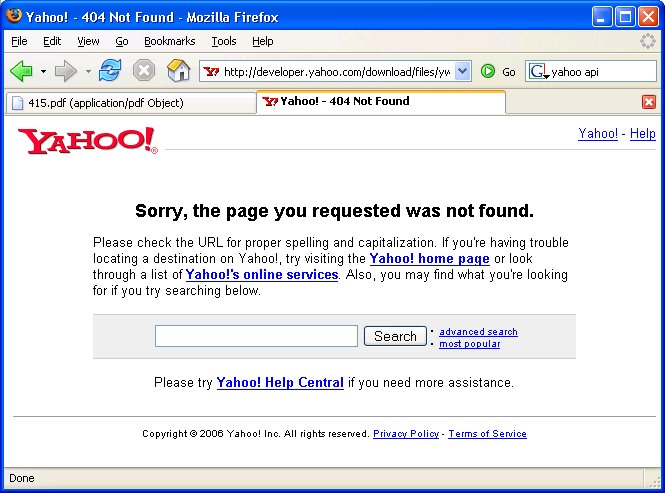
Just today I noticed that my Perl scripts (including Warrick) running the Yahoo Web Search API were consistently returning zero results. I tried running the scripts from different networks, but had the same problem. I scanned the Yahoo API web pages to see if they were alerting us to any problems and nothing.

So I though maybe I should download the most recent version of the API just in case something has changed. I tried downloading yws-1.2.tgz and yws-1.2.zip but got the same error page (right).

I also tried sending an email to the Yahoo list (yws-search-web@yahoogroups.com) but never received the email as a member of the group. Something is really fishy…

Update on 3/13/06:

Yahoo finally admitted the error today. Acording to Toby Elliott, the Yahoo API guy, the error is due to a "default variable in the perl library" and a fix should be out soon. Several other developers complained to the Yahoo list serve, but all the emails were held until today. One noted that the error first appeared on Mar 3. That means it took 10 days for the API error to be acknowledged. Ouch! Was it because Toby was on vacation? ;)

Something else strange: a few days ago I did a Google search for "yahoo api" which resulted in two hits: one pointing to developer.yahoo.net and one to developer.yahoo.com. The sites appeared to be mirrors of each other. One big difference though, the download page for the .com resulted in 404s (see above) but the .net site didn't. A googling of "yahoo api" today just shows only the .net listing. I guess I caught them in the middle of their migration from one TLD to another.

Update on 3/27/06:

I was able to find a working Perl library for Yahoo's Web Search API at CPAN.