Showing posts with label google api. Show all posts

Thursday, January 07, 2010

Warrick is back in action

Warrick, the service I created several years ago to recover lost websites, has been revived. I took its web interface out of commission about a year ago when we received more jobs then we could ever process in 2009. But I've decided to wipe out the old jobs and start fresh. I'm curious to see how quickly we receive more jobs than we can handle in 2010.

Some stats. Since July 2007 when Warrick's web interface was first made public, we have recovered 4287 websites and 3,508,091 URIs. That's a lot of missing material the public wants back.

I've also updated Warrick:
Happy website reconstructing.

Tuesday, June 10, 2008

Using Google's AJAX Search API with Java

I was rather sad a year ago when Google deprecated their SOAP Search API with their AJAX Search API. Essentially Google was saying that they didn't want anyone programmatically accessing Google search results unless they were going to be presenting the results unaltered in a rectangular portion of a website. This was particularly troubling to me because, like many academics, I have relied on the API to do automated queries, especially for Warrick.

A few months ago I got a little excited when Google opened their AJAX API to non-JavaScript environments. Google is now allowing queries using a REST-based interface that returns search results using JSON. The purpose of this API is still to show unaltered results to your website's user, but I don't see anything in the Terms of Use that prevent the API being used in an automated fashion (having a program regularly execute queries), especially for research purposes, as long as you aren't trying to make money (or prevent Google from making money) from the operation.

UPDATE: The AJAX web search API has been deprecated as of November 1, 2010. I do not know of a suitable replacement.

So, here's what I've learned about using the Google AJAX Search API with Java. I haven't found this information anywhere else on the Web in one spot, so I hope you'll find it useful.

Here's a Java program that queries Google three times. The first query is for the title of this blog (Questio Verum). The second query asks Google if the root page has been indexed, and the third query asks how many pages from this website are indexed. (Please forgive the poor formatting... Blogger thinks it knows better than I how I want my text indented. Argh.)

import java.io.BufferedReader;
import java.io.InputStreamReader;
import java.net.URL;
import java.net.URLConnection;
import java.net.URLEncoder;
import org.json.JSONArray; // JSON library from http://www.json.org/java/
import org.json.JSONObject;

public class GoogleQuery {

// Put your website here
private final String HTTP_REFERER = "http://www.example.com/";

public GoogleQuery() {
makeQuery("questio verum");
makeQuery("info:http://frankmccown.blogspot.com/");
makeQuery("site:frankmccown.blogspot.com");
}

private void makeQuery(String query) {

System.out.println("\nQuerying for " + query);

try
{
// Convert spaces to +, etc. to make a valid URL
query = URLEncoder.encode(query, "UTF-8");

URL url = new URL("http://ajax.googleapis.com/ajax/services/search/web?start=0&rsz=large&v=1.0&q=" + query);
URLConnection connection = url.openConnection();
connection.addRequestProperty("Referer", HTTP_REFERER);

// Get the JSON response
String line;
StringBuilder builder = new StringBuilder();
BufferedReader reader = new BufferedReader(
new InputStreamReader(connection.getInputStream()));
while((line = reader.readLine()) != null) {
builder.append(line);
}

String response = builder.toString();
JSONObject json = new JSONObject(response);

System.out.println("Total results = " +
json.getJSONObject("responseData")
.getJSONObject("cursor")
.getString("estimatedResultCount"));

JSONArray ja = json.getJSONObject("responseData")
.getJSONArray("results");

System.out.println("\nResults:");
for (int i = 0; i < ja.length(); i++) {
System.out.print((i+1) + ". ");
JSONObject j = ja.getJSONObject(i);
System.out.println(j.getString("titleNoFormatting"));
System.out.println(j.getString("url"));
}
}
catch (Exception e) {
System.err.println("Something went wrong...");
e.printStackTrace();
}
}

public static void main(String args[]) {
new GoogleQuery();
}
}

Note that this example does not use a key. Although it is suggested you use one, you don't have to. All that is required is that you put your website or the URL of the webpage that is making the query in the query string (coming from the HTTP_REFERER constant).

When you run this program, you will see the following output:
Querying for questio verum

Total results = 1320

Results:
1. Questio Verum
http://frankmccown.blogspot.com/
2. Questio Verum: URL Canonicalization
http://frankmccown.blogspot.com/2006/04/url-canonicalization.html
3. WikiAnswers - What does questio verum mean
http://wiki.answers.com/Q/What_does_questio_verum_mean
4. Amazon.com: Questio Verum "iracund"'s review of How to Get Happily ...
http://www.amazon.com/review/R3VRSYWW5EJZFH
5. Amazon.com: Profile for Questio Verum
http://www.amazon.com/gp/pdp/profile/A2Q6CLLQPXG55A
6. How and where to get Emerald? - Linux Forums
http://www.linuxforums.org/forum/ubuntu-help/119375-how-where-get-emerald.html
7. Lemme hit that wifi, baby! - Linux Forums
http://www.linuxforums.org/forum/coffee-lounge/122922-lemme-hit-wifi-baby.html
8. [SOLVED] lost in tv tuner hell... please help - Ubuntu Forums
http://ubuntuforums.org/showthread.php%3Fp%3D3802299


Querying for info:http://frankmccown.blogspot.com/

Results:
Total results = 1

1. Questio Verum
http://frankmccown.blogspot.com/


Querying for site:frankmccown.blogspot.com

Total results = 463

Results:
1. Questio Verum
http://frankmccown.blogspot.com/
2. Questio Verum: March 2006
http://frankmccown.blogspot.com/2006_03_01_archive.html
3. Questio Verum: December 2006
http://frankmccown.blogspot.com/2006_12_01_archive.html
4. Questio Verum: June 2006
http://frankmccown.blogspot.com/2006_06_01_archive.html
5. Questio Verum: October 2007
http://frankmccown.blogspot.com/2007_10_01_archive.html
6. Questio Verum: July 2007
http://frankmccown.blogspot.com/2007_07_01_archive.html
7. Questio Verum: April 2006
http://frankmccown.blogspot.com/2006_04_01_archive.html
8. Questio Verum: July 2006
http://frankmccown.blogspot.com/2006_07_01_archive.html

The program is only printing the title of each search result and its URL, but there are many other items you have access to. The partial JSON response looks something like this:
"GsearchResultClass": "GwebSearch",
"cacheUrl": "http://www.google.com/search?q=cache:Euh9Z1rDeXUJ:frankmccown.blogspot.com",
"content": "<b>Questio Verum<\/b>. The adventures of academia, or how I learned to stop worrying and love teacher evaluations.*. Saturday, June 07, 2008 <b>...<\/b>",
"title": "<b>Questio Verum<\/b>",
"titleNoFormatting": "Questio Verum",
"unescapedUrl": "http://frankmccown.blogspot.com/",
"url": "http://frankmccown.blogspot.com/",
"visibleUrl": "frankmccown.blogspot.com"

So, for example, you could display the result's cached URL (Google's copy of the web page) or the snippet (page content) by modifying the code in the example's for loop.

You'll note that only 8 results are shown for the first and third queries. The AJAX API will only return either 8 results or 4 results (by changing rsz=large to rsz=small in the query string). Currently there are no other sizes.

You can see additional results (page through the results) by changing start=0 in the query string to start=8 (page 2), start=16 (page 3), or start=24 (page 4). You cannot see anything past the first 32 results. In fact, setting start to any value larger than 24 will result in a org.json.JSONException being thrown. (See my update below.)

More info on the query string parameters is available here.

From the limited number of queries I've ran, the the first 8 results returned from the AJAX API are the same as the first 8 results returned from Google's web interface, but I'm not sure this is always so. In other words, I wouldn't use the AJAX API for SEO just yet.

One last thing: the old SOAP API had a limit of 1000 queries per key, per 24 hours. There are no published limits for the AJAX API, so have at it.

Update on 9/11/2008:

Google has apparently increased their result limit to 64 total results. So you can page through 8 results at a time, up to 64 results.

Saturday, May 10, 2008

Fav5

My pick of the week's top 5 notable items:
  1. Ye-haw! They brought it back! (Kind of). Google stopped supporting their SOAP-based API for obtaining search results back in Dec. 2006. It was a huge disappointment to many. But now they have released a REST-based API which should be sufficient for many researchers like myself that need an automated way of querying Google. I'll give it a try soon and report back. (Thanks, Michael and Olena, for the tip.)

  2. Joel Spolky rants about architecture astronauts, Windows Live Mesh, and Google paying fresh CS graduates too much money. (Thanks, Alan, for the tip.)

  3. Viewzi is a new metasearch engine (a search engine which combines results from many different sources) which shows some promise. They have many different "views" of the search results which are extremely different than what Google might give you. As you can see from the screenshot below, they are still experiencing a few technical problems (they can't seem to display Harding's home page), but overall I am very pleased with the results.


    Currently, you have to sign up for an account to use viewzi. You can use the code "gio" to get an account. (Thanks again, Alan.)

  4. A new computer game involving folding proteins could allow a 13 year-old to someday win a Nobel Prize.

  5. And finally, a 17 year-old has developed a multi-touch table running Mac OS X for a science fair. Maybe we should get him to play the "folding proteins" game. (Thanks again X3, Alan.)

Tuesday, March 20, 2007

Search engine interfaces and their APIs - How synchronized are they?

A few months ago I gave a little teaser about some research I was doing comparing the results you receive from the search engine APIs of Google, Yahoo, and MSN with the results that you see when you use their web user interface (WUI). The WUI is a fancy term for the little search box that you enter your queries into.

Most API users think that if they search for “march madness”, for example, that the returned results will be equivalent to what they would see if they searched for “march madness” using the WUI. In practice, this rarely occurs.

This leads us to ask, how different are the search engine API results from the WUI results? Are the APIs serving off of older indexes? Smaller indexes? Which search engine offers the most synchronized interfaces?

I will be presenting the answer to these questions at this year’s ACM IEEE Joint Conference on Digital Libraries (JCDL) this June in a paper entitled Agreeing to Disagree: Search Engines and their Public Interfaces. I’ll also be presenting a summary of my findings as a poster at the World Wide Web conference in May. Detailed findings can be found here. If you attend either of these conferences, please come by and introduce yourself... I’d be happy to discuss my findings with you.

By the way, if you haven't heard already, Google's SOAP web search API has been "depricated."

Friday, January 19, 2007

No more searching for you: Google drops the SOAP

In case you were asleep at the helm like I was, Google has pulled the plug on their SOAP-based web search API. On Dec 5, 2006, Google stopped giving users new API keys. They claim the API service will continue to run, but without a method for obtaining new keys, it essentially becomes worthless (API keys can't be shared since they are tied to a specific individual's Google account, and I can't let you run my application unless you supply it with your own key).

Google has decided their AJAX search API is the wave of the future. But why the "odd move"? I think Jason Lefkowitz summed it up best:
Today, though, Google isn’t about search. It’s about displaying ads. And in that context, an open API makes no sense — the developer can reformat the search results, and even show them (gasp) without ads!

Hence the “AJAX API”, which forces you to take the ads along with the search results. You can’t really do much with it, but it does create a new place for Google to show ads on — your blog/site/Web app.
I don’t have a problem with Google focusing on their AJAX search API... I’m sure it’s very useful in many contexts, but I do have a problem with them abandoning their SOAP search. Not only is Google putting the smack down on the SEO business (one of their intended victims, in my opinion), they are hurting us web researchers who depend on automated methods of querying Google.

I can point to a huge stack of academic papers that, without an effective method of automatically querying Google, are un-reproducible (Google- do you really want everyone to go back to page-scraping?). And it’s really hurting my research: Warrick will not work for new users without API keys. I’ve spent lots of time writing wrappers around the SOAP API code, now I’ll have to redo most of when I find an effective method of accessing Google’s cache. Until then, you can kiss your lost website goodbye if Google is the only one who has cached it.

It sometimes appears that have a love/hate relationship with Google. Yesterday I was singing it's praises, today not so much. In honor of the SOAP API, I’ve put together a brief timeline for us all to reflect upon:
  • Pre 2002 - Page-scraping is the norm, and there is great frustration.
  • 2002 – Google launches the first search engine API, and there is great rejoicing.
  • 2002-2005 – Researchers use the API to for all sorts of interesting experiments, SEOs do their best to reverse engineer PageRank, new services are built, books are written, and, despite many technical difficulties along the way, there is much satisfaction.
  • 2006 – Google tightens the lid on extra queries per key, and there is much displeasure.
  • Late 2006 – Google refuses to give new API keys, and there is much sadness and anger.
  • Late 2007 (My prediction) - Google’s SOAP API breaks, no one fixes it, and there is no surprise. RIP

Update on July 27, 2007:

Google has just released an academic API for researchers: University Research Program for Google Search. Now that's more like it.


Update on Sept 30, 2009:

Google has finally killed its SOAP Search API.

Friday, November 03, 2006

Do the search engine APIs lie?

OK, the title of this post is a little strong. Search engine APIs don't intend to deceive anyone, but they typically do not give the same result as what the rest of the world sees when using the public web interfaces.

Everyday for the past 5 months I’ve been sending thousands of queries to the Google, MSN, and Yahoo on the Internets using the web user interface (WUI), the little box that everyone types their queries into, and using the web search APIs that each of the search engines makes available for free to the public. There’s been a lot of questions as to whether the APIs give the same results as the WUIs, and I’m going to be the first to provide a strong quantitative analysis to see which API's are the most synchronized with their WUIs.

In order to process the incredible amount of data I’ve been collecting, I’ve developed an elaborate set of Perl scripts that transform the raw collected data into tables that are then imported into MySQL. The scripts take several days to complete processing. Then I’ve developed numerous R scripts that pull data from MySQL and plot them to an array of graphs.

I’m currently working on writing up my findings for a conference. If you’d like a pre-print of my paper, I’d be happy to share it with you. Here’s a little teaser.


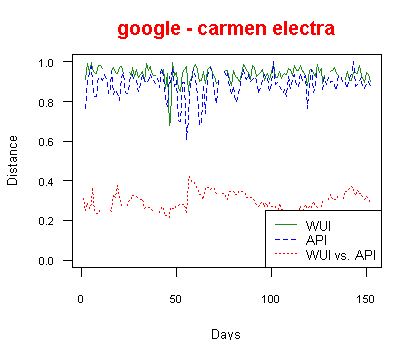
The graph above shows the daily Kendall tau distance between the top 100 search results obtained from Google’s WUI and API for the term carmen electra. The green line shows how the WUI results change every day, and the blue like shows how the API results change every day. If the results are exactly the same (including their ranking), the distance is 1, but if the results have nothing in common, the distance is 0. The red line shows the distance between the WUI and API results each day. You’ll notice that for the most part the WUI and API values don’t move in a synchronized way, and the WUI and API results are very dissimilar. Other popular search terms like stacy keibler, jessica simpson, and lindsay lohan exhibited similar patterns (although the WUI vs API distance was closer to about 0.8). When we examine search results for terms like nfl football or computational complexity, the WUI and API results are very synchronized, and the WUI vs API distance is closer to 0.9. Maybe they purposefully discriminate against air-heads?


This graph shows the decay of the search results for the term subroutine for all three search engines. To compute decay, I compared the results obtained on each day with each of the results after that day using a normalized overlap measure. In other words, I computed the percentage of results that were shared between the results obtained on day 1 with day 2, 3, 4, etc. Yahoo shows a strong decay line with a half-life of 30 (on day 30 half of the results were gone). Google and MSN show decay lines that actually un-decay (if there is such a word). After several months of the results becoming more different, the results start to return back to their starting point.


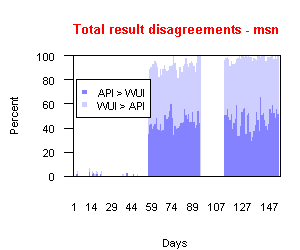
One last graph: how many times does the WUI and API agree when asked for the total number of results for a search term? For all three search engines, the answer is almost always zero! But if you look at the graph above, you’ll see that the MSN total results used to agree almost every time until day 58 (late July) when they changed something internally. Now about half of the time their WUI gives a larger number, and the half of the time the API gives a larger number. By the way, the gap under day 107 was due to MSN invalidating our API license key. It took me 17 days before I replaced the key. Moral of the story- keep a close eye on your experiments!

Tuesday, June 20, 2006

Integer problems for the Google API

I’m not sure when it first started, but the Google API has been bombing out over the last few months when returning over 2^31 (2,147,483,648) results for a query. The API has bombed-out almost every day in June when my script searching for “database” and “list” which each return several billion results. Apparently Google’s SOAP interface is using a 32-bit integer for returning the total pages returned, but they need to be using a 64-bit long integer.

Michael Freidgeim made note of the problem on his blog a few weeks ago. Others have noticed this problem going back to April 2006. Who knows when Google will make a fix. If it's not one thing, it's something else... ;)

When searching to see when Google started using the larger total results, I came across a posting by Danny Sullivan that shows how he was attempting to use a “trick” to reveal how many pages Google has indexed. Danny suggested issuing a query that says, “give me all the pages that don’t have the word asdkjlkjasd.” I just tried –asdkjlkjasd on Google, and it gives me back 20.7 billion results. MSN gives around 5.2 billion results, but Yahoo and Ask won’t accept the query. Interesting…

Friday, June 16, 2006

End of the Google 502 errors?

Google users have sporadically seen Google 502 (bad gateway) errors the last several years. The errors appear momentarily and then disappear. I’ve linked to a few postings about it according to date:

Mar 2003
July 2003
June 2005
Sept 2005
Nov 2005
Feb 2006
May 2006

Google API users have seen the 502 errors much more frequently:

Nov 2005, and another
Dec 2005
Jan 2006
Feb 2006, and another
May 2006

From my investigations, it looks like Nov 2005 is when the problems began. I have personally dealt with the problem ever since Mar 2006 when I integrated the Google API into Warrick. I had to add some logic to sleep for 15-20 seconds when encountering the error and then re-try.

In late May I started a new experiment which uses the Google API, and I’ve been monitoring it daily to see how many 502 errors I was receiving. From late May to June 6, I consistently received a 502 error for about 30% of my requests. On June 7, the number of 502s went down to zero. I have only received an occasional 502 out of hundreds of requests made daily.

Someone at Google finally got sick of the bad press and made some changes, and I’m thankful for it. :)

Thursday, May 25, 2006

Google limiting researchers to 1000 queries

I recently read a poster from ISSI 2005 entitled “Google Web APIs - an Instrument for Webometric Analyses?” The poster was written by Philipp Mayr and Fabio Tosques to introduce the Google API to webometric researchers. They ran several experiments to demonstrate that the API was useful. One experiment queried Google’s web interface and API with the term “webometrics” over 240 days. Their results showed a huge difference between the web interface and the API which made me wonder how you can consider an API useful if it gives you far different responses from what the rest of the world is seeing.

In their conclusion, Mayr and Tosques reported a limit of 10,000 requests per day. Google only allows 1000, so I emailed Mayr to see why they reported 10,000. He replied that Google would give researchers more queries, but when I emailed api-support@google.com requesting a bump up, they replied with this:
Due to overwhelming demand, we are no longer accepting requests for additional queries or for commercial use permission.
So researchers are in a quandary: use Google’s public web interface to perform searches which frequently (in my experience) leads to being blacklisted for hours at a time (even when less than 1000 daily queries are being made), or use the buggy (502 errors are common) API with only 1000 daily query limit which returns very different results than those obtained through the web interface.

Inspired by this dilemma, I have decided to put the APIs from Google, MSN, and Yahoo to the test. I am running a series of experiments comparing what the APIs return to what the web interfaces return. I’m hoping this will result in something that will give researchers a little more information on how to go about using search engines in their experiments and what to expect when using the APIs. Now if I can just find a free server that I can use to make requests for a few months…

Tuesday, January 10, 2006

Google Is Sorry

Google has been really confusing some of its users recently with their “Google is sorry” web page. The page reads like this:

We're sorry... but we can't process your request right now. A computer virus or spyware application is sending us automated requests, and it appears that your computer or network has been infected. We'll restore your access as quickly as possible, so try again soon. In the meantime, you might want to run a virus checker or spyware remover to make sure that your computer is free of viruses and other spurious software. We apologize for the inconvenience, and hope we'll see you again on Google.

It appears this page started appearing in mass around Nov-Dec of 2005. There are many discussions about it in on-line forums. Here are 2 of them that garnered a lot of attention:

  1. Webmasterworld.com
  2. Google groups

I ran into the error when modifying Warrick to use the “site:” parameter in order to better reconstruct a website. Unfortunately I had to drop the feature, and although I’m still making automated queries, I’ve yet to see the page again.

Google appears to be mum about the whole thing. The most credible explanation I found was here:

http://www.emailbattles.com/archive/battles/virus_aacdehdcic_ei/

Apparently it is a new "feature" of Google that is getting back at bandwidth-hogging SEOs that use automated queries with "site:" or "allinurl:" in them. Their IA is a little over-zealous and is hurting the regular human user and the user like me who is performing very limited daily queries for no financial gain.

Update on 3/8/2006:

Google has caught me again! Although my scripts ran for a while without seeing the sorry page, they started getting caught again in early Feb. I conversed with someone at Google about it who basically said sorry but there is nothing they can do and that I should use their API.

The Google API is rather constrained for my purposes. I've noticed many API users venting their frustrations at the inconsistent results returned by the API when compared to the public search interface.

I finally decided to use a hybrid approach: page scraping when performing "site:" queries and the API to access cached pages. I haven't had any trouble from Google since.