Showing posts with label books. Show all posts

Tuesday, July 13, 2010

CS library book analysis

For the past three years I've been the designated faculty member in charge of ordering computing books for our campus library. Although it can be tedious at times, I usually enjoy the job, especially since it gives me the chance to browse through the latest books on computing and order pretty much what I would like (and, of course, what I think the students would like smile).

The other day I got to wondering though, how many of these books are our students actually checking out? Are paper-bound books still useful to them when you can find so much information on the Web?

So several months ago I asked our librarian to give me some usage data on our computing books. I was only able to analyze the data this week, and what I found was somewhat surprising.

First, to see the relative age of books in our library, I created a histogram of the 998 books based on publication date:


The earliest book (Computers and Society, edited by Nikolaieff) is from 1970. Almost half of the books (45%) were published between 1999 and 2003. Only three books published this year had made it into the library by the time this data was obtained.

The check-out data was from 2001 to present. Out of 998 books, 22% have never been checked out (at least since 2001). Eighteen percent have only been checked out once, and only 25% have been checked out more than five times.

Below is a histogram with log scale showing how many times our books have been checked out. The largest bar on the left is the 75% chunk of books that have been checked out 0-5 times. There are only two books that have been checked out 31-35 times and only one book that has been checked out more than 40 times.


In case you were wondering, here are the top 10 most frequently checked-out computing books, along with the book's publication date and number of times checked out. Many of these books are not surprises:
  1. Introduction to Algorithms by Cormen, Leiserson, & Rivest (1990) - 41
  2. C++ Primer Plus: Teach Yourself Object-Oriented Programming by Prata (1995) - 35
  3. Applied cryptography: Protocols, algorithms, and source code in C by Schneier (1994) - 35
  4. Design Patterns: Elements of Reusable Object-Oriented Software by Gamma et al. (1995) - 30
  5. C++ How to Program: Introducing Object-Oriented Design with the UML by Deitel & Deitel (2001) - 26
  6. Computer Virus Crisis by Fites, Johnston, & Kratz (1992) - 26
  7. PASCAL: Programming and Problem Solving by Leestma & Nyhoff (1990) - 25
  8. Mythical Man-Month: Essays on software engineering by Brooks (1995) - 25
  9. C#, A Programmer's Introduction by Deitel et al. (2003) - 25
  10. HTML and CGI Unleashed by December & Ginsburg (1995) - 25

So what about the books that no one checks out? Browsing through the list, I see what I assume would be very popular books like Pattern Hatching: Design Patterns Applied by Vlissides (1998), Object Oriented Perl by Conway (2000), User Interface Design for Programmers by Spolsky (2001), SQL in a Nutshell by Kline et al. (2004), and iPhone SDK 3 Programming by Ali (2009).

To get a better overall picture, I looked at the percentage of books by publication year that have been checked out (at least once since 2001) as shown below.


There is an even decline in check-out rates from 1995 on which suggests that the longer a book is around, the more likely it is to be checked out. That certainly makes sense, however the longer most computing books are around, the less useful they become.

For example, Designing with Web Standards by Zeldman (2007) has been checked out five times. This is arguably a relevant book, at least until HTML5 is released as a new web standard; then its value plummets. Browsing through the titles of our books, many of them fall into this category. Even among our most checked-out books, several of them are somewhat outdated (3?, 6, 7, 9, 10). This is the greatest problem I face when purchasing CS books for the library... I try to purchase books that I think will be immediately useful to our students and at the same time have a shelf-life greater than one year. It's not an easy balance to maintain.

Returning to my original question, are library books still used by our CS students? The data seems to suggest that a fair amount of books are eventually checked out at least once. However, if we estimate that a book costs around $50, and 218 books have never been checked out, that means $10,900 worth of books are sitting unused on the library shelves. Ouch.

Of course, a more thorough analysis would involve surveying our students about their library usage. Why are they checking out a particular book? Are they actually reading what they check out? Is the information they are seeking in the book they've checked out? Are they finding what they need in the library? Are they finding equivalent information on the Web and therefore don't need the book? This would certainly make for an interesting study.

So, do you still find computing books useful? Should we be purchasing fewer books? What would be a better use for the money?

Tuesday, September 08, 2009

Summer reading

Here's a list of the books I finished reading this summer. I'm looking for some titles to read next, so feel free to leave me a recommendation.

The Seven Faith Tribes by George Barna. This book is subtitled, "Who They Are, What They Believe, and Why They Matter," but I think a more accurate description of the book would be "Who They Are and How They Better Get Along Before All Hope Is Lost". Barna uses his massive amounts of survey data to identify seven faith tribes of America: Casual Christians (making up 2/3 of all Americans), Captive Christians (16%), Jews (2%), Mormons (1.5%), Pantheists (1.5%), Muslims (.5%), and Skeptics (11%). Barna outlines 20 shared values between the tribes (e.g., represent the truth well, develop inner peace and purity, seek peace with others, etc.) and calls all tribes to band together and push these values into the media, government, and families, to advance our common national interests. While I admire Barna's call to us all to unite and help our country, the lack of implementation specifics left me somewhat skeptical.

Outliers by Malcolm Gladwell. This book is an informative and entertaining weaving together of various studies and anecdotes that shed light on the (often overlooked) significant factors that lead to success. There's an excellent chapter (Ch 2) that talks about Bill Joy and other computing luminaries which is worth reading, even if you don't want to read the whole book.

Blink by Malcolm Gladwell. I enjoyed Outliers so much that I was inspired to read Blink. It focuses on the abilities and distractions caused by our unconscious minds. Gladwell focuses on "thin-slicing", the ability to determine what is important from just a very small amount of information, and how it can be influenced by prejudice and stereotypes. I enjoyed Blink, but not as much as I did Outliers. Tipping Point is next on my list.

The Bravehearted Gospel by Eric Ludy. Christianity has gone soft over the years, and Ludy calls for us to reclaim the Truth of the Bible. I really enjoyed the rallying cry, but I'm still digesting this one.

Surprised by Hope by N. T. Wright. OK, I've been reading this for more than a year and still have about 50 pages to go. It's tough reading but, Wright makes a good case that a Christian's hope should be based on the future resurrection, not "going to heaven." If you enjoy thinking deeply about eschatology, this book is for you.

Saturday, December 30, 2006

Favorites of 2006

Here are some of my favorite things from 2006.

On-line laughs:
  1. The most-viewed YouTube video of 2006: The Evolution of Dance by Judson Laipply
  2. Possibly the worst recording of O Holy Night, ever
  3. David Brent's Microsoft training video
  4. The Iraq Report with subtitles
  5. Two sons try to take a Mother’s Day photo (these guys must know my brother and me)

TV commercials:
  1. Liberty Mutual "pay-it-forward" commercial
  2. LA County Fair - "Duh, Ashley, all wool comes from a cow..."
  3. “That should kill him…” Ameriquest doctor commercial
  4. Peyton Manning supporting his team

Movies I saw:
  1. The Prestige - It had me on the edge of my seat the entire time
  2. X-Men: The Last Stand - I hope this won’t be the last of the series
  3. Facing the Giants - Created by a church with no professional actors, it's a very moving and inspirational film
  4. Invincible - Almost makes me want to be a Phily fan
  5. Casino Royale - A little on the violent side, but probably the best Bond yet
  6. Flags of Our Fathers - War is tragic

Books I read:
  1. The Language of God by Francis Collins - Collins does a great job of distilling the myth that evolution = atheism
  2. Freakonomics by Steven D. Levitt and Stephen J. Dubner - Some interesting things to think about
  3. Sacred Marriage by Gary Thomas - Rather than make us "happy", marriage is designed by God to make us more holy
  4. Finding God at Harvard by Kelly Monroe - A series of encouraging stories from various Harvard alums about their path to faith

Websites I love to visit:
  1. Wikipedia.org – Sometimes you have to sort through a lot of “truthiness”, but it’s an extremely useful tool for answering the question “What is X?”
  2. YouTube.com – It feeds my addiction for funny commercials
  3. Google Scholar – OK, I don’t love to visit this site, but it's probably the #1 reason why getting my Ph.D. will take less than 4 years. It’s much larger and faster than Citeseer and far easier to use than Windows Live Academic

Tuesday, October 17, 2006

Back from the Bahamas

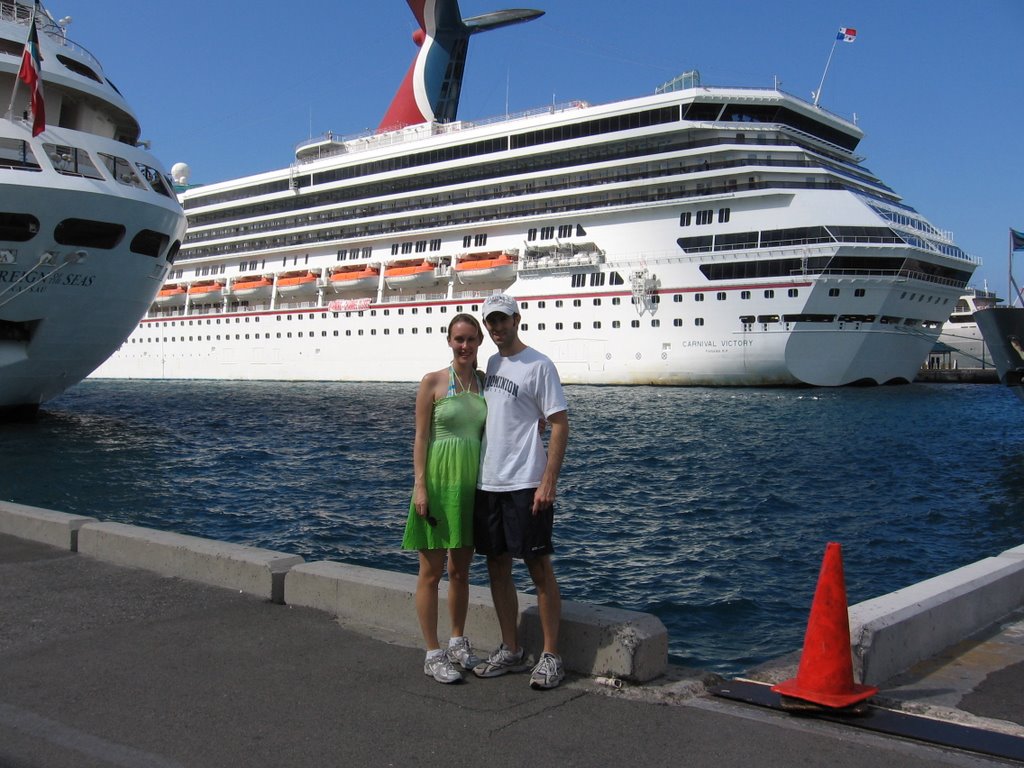
Becky and I returned Saturday morning from our cruise to the Bahamas. Our room on board was spacious, and we loved getting breakfast in bed and twice-daily room service. We had a great time snorkeling in Nassau and the Atlantis hotel, and the beach in Freeport was incredible. I celebrated my birthday onboard and got to blow out candles on a cake of Baked Alaska.


Besides getting to spend a lot of time with Becky, I also had plenty of time to read. I brought along a book called The Language of God: A Scientist Presents Evidence for Belief by Francis S. Collins, the head of the Human Genome Project. Collins does a fantastic job at presenting how science and faith can be and should be integrated. Collins is an excellent communicator, and he especially does a good job of summarizing the current state of scientific knowledge. I highly recommend this book to the atheist, agnostic, and believer. I found the Language of God and Finding God at Harvard (which I just completed last month) to be very encouraging to my faith.

Now it’s back to the grindstone...